
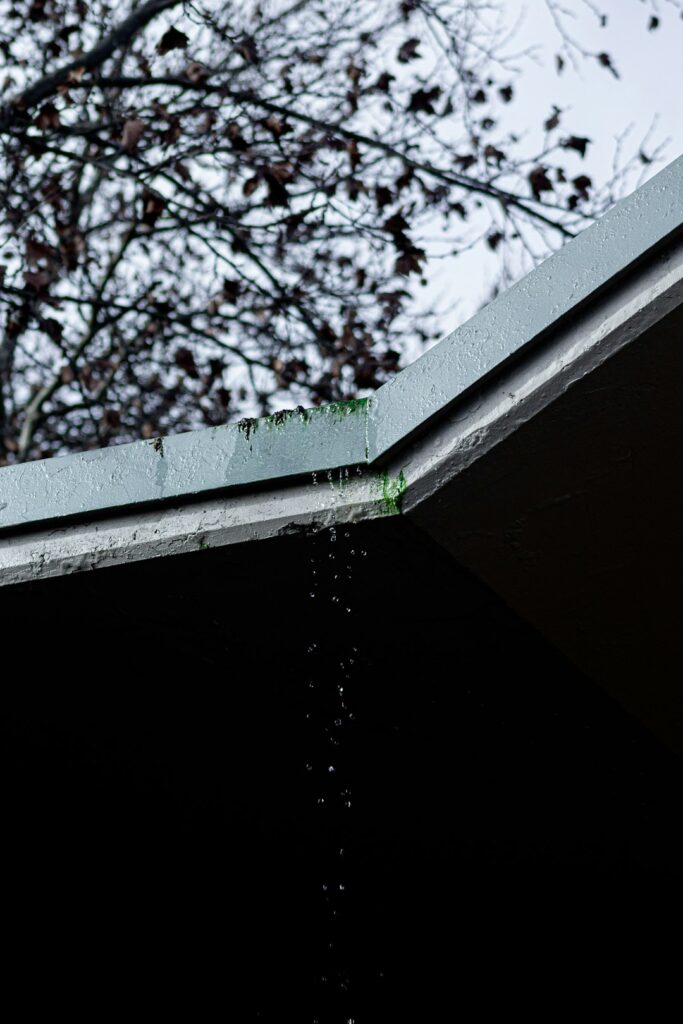
Gutters are part of a roofing system, not just an accessory attached to the edge of a house. Their job is to collect rainwater and melting snow, then direct it away from roof edges, walls, windows, foundations, and walkways. When gutters become clogged, damaged, or poorly drained, the roof can be exposed to moisture problems that may develop slowly and remain hidden for months.
For homes in Dunkirk, NY, regular gutter cleaning is especially useful because the area experiences substantial precipitation, winter snow, freeze-thaw cycles, and seasonal leaf fall. These conditions place repeated stress on roof drainage.
How can clogged gutters damage a roof?
Clogged gutters prevent water from leaving the roof efficiently. During rain, water may spill over the front edge of the gutter or back up beneath the roofing materials at the eaves.
That backup can affect several parts of the roof:
- Roof edges: Constant moisture can soften wood components beneath the shingles.
- Fascia and soffits: Overflowing water may stain, swell, or deteriorate the boards along the roofline.
- Shingles: Water that remains trapped near the lower edge can contribute to curling, cracking, or premature loss of protective granules.
- Roof decking: Persistent dampness may encourage rot or create conditions favorable to mold growth.
- Attic insulation: Moisture entering near the eaves can reduce insulation performance and contribute to elevated attic humidity.
A gutter does not need to be completely full to create a problem. A partial blockage at a downspout entrance can slow drainage enough to cause overflow during a heavy storm.
Why does gutter cleaning matter during winter?
Gutter cleaning before winter helps reduce the risk of ice-related stress, although it cannot prevent every ice problem. Leaves, twigs, and sediment hold moisture in the gutter. When temperatures fall, that trapped water can freeze and expand.
Heavy ice inside a gutter may:
- Pull the gutter away from the fascia
- Bend or loosen hangers
- Add weight to the roof edge
- Block normal drainage
- Increase the chance of water backing up under shingles
Freeze-thaw conditions are a particular concern. Snow may melt during a warmer afternoon, flow into a clogged gutter, and freeze again overnight. Repeated cycles can turn a small blockage into a heavy, rigid mass.
Ice dams are not caused by gutters alone. They are usually related to heat loss through the roof, attic insulation, ventilation, outdoor temperature, and snow conditions. However, blocked gutters can make drainage problems worse by preventing meltwater from moving away from the roof.
How often should gutters be cleaned?
Most homes benefit from cleaning at least twice a year: once in late spring and again in late fall. The exact schedule depends on the property.
More frequent attention may be needed when a home has:
- Mature trees near the roof
- Pine needles or seed-producing trees overhead
- Multiple roof levels
- Valleys that collect debris
- A low-slope roof section
- Gutter guards that still allow fine material to pass through
- Downspouts close to heavy landscaping or soil
A useful rule is to inspect the gutters after major leaf drop and before the first sustained period of freezing weather. A visual check after a strong windstorm can also reveal branches, shingle granules, or other debris that may interfere with drainage.
What signs suggest the roof is being affected?
Roof and gutter problems often appear together. Warning signs around the exterior include water stains beneath the eaves, peeling paint, sagging gutters, or soil erosion below the downspouts.
Other signs may be less obvious:
- Dark streaks or damp areas along the fascia
- Shingles that appear lifted near the roof edge
- Rusted or separated gutter joints
- Water marks on attic rafters or roof decking
- Damp insulation near exterior walls
- Drips from the underside of gutters during light rain
- Puddles forming directly below the roofline
- Gutter sections that pull away after snow or ice
A roof leak does not always begin directly above the interior stain. Water can travel along decking, rafters, or insulation before appearing inside the home. That is why gutter and roof drainage should be considered when investigating moisture near exterior walls or ceilings.
Can clean gutters help prevent foundation and siding damage?
Yes. Properly functioning gutters reduce the amount of water that falls beside the foundation and runs down exterior walls.
When water repeatedly lands near the foundation, it can contribute to:
- Soil erosion
- Basement or crawl-space moisture
- Efflorescence on masonry
- Damp siding or trim
- Splashback onto lower walls
- Settlement around downspout discharge areas

The relationship between gutters and roofing is direct. If downspouts are blocked, disconnected, or releasing water too close to the house, the roof may be draining correctly at the gutter but still sending water to an unsafe location.
Downspouts should discharge far enough away from the foundation to prevent concentrated runoff from collecting at the base of the wall. The outlet should also remain clear of ice, leaves, mulch, and compacted soil.
Are gutter guards maintenance-free?
No. Gutter guards can reduce the amount of large debris entering a gutter, but they do not eliminate maintenance. Small leaves, seeds, roof grit, pollen, and fine organic material may collect on top of or beneath the guard.
During winter, some guard designs can also retain snow or ice along the roof edge. Their performance varies according to the roof design, tree cover, debris type, and installation quality.
Even with guards, homeowners should inspect:
- The top surface for packed debris
- The gutter channel for sediment
- The downspout opening for blockages
- Seams and corners for leaks
- Brackets and hangers for movement
Cleaning the visible gutter but ignoring the downspout can leave the main drainage problem unchanged.
What is a safe gutter-cleaning approach?
Gutter cleaning involves ladders, wet surfaces, unstable soil, and overhead roof edges. It should not be treated as a routine ground-level chore when conditions are hazardous.
Avoid working during rain, high winds, icy weather, or when the ground is soft and uneven. Extension ladders should be placed on stable footing and used according to their safety instructions. Roof walking is generally riskier than working from a properly positioned ladder, especially when shingles are wet, frosted, or covered with moss.
If the home is tall, the roof is steep, the gutters are difficult to reach, or electrical lines are nearby, the safest choice may be to avoid the task rather than attempt it under unsafe conditions.
What should be checked after cleaning?
After debris is removed, run water through the gutter system and observe how it moves. Water should flow toward the downspout without pooling or spilling over the front edge.
Also check for:
- Loose or sagging sections
- Open seams
- Cracked elbows
- Missing downspout extensions
- Water escaping behind the gutter
- Shingle granules collecting in large amounts
- Wood that feels soft or appears discolored
Regular observation helps distinguish a simple cleaning issue from a larger roof drainage or moisture problem. In a climate with heavy rain, snow, and repeated freezing and thawing, that distinction can help prevent a minor blockage from becoming roof-edge deterioration.
